
Why Degrowth Doesn't Help the Climate
We need wind turbines, not a recession.


Thomas Piketty, French economist and author of Capital in the 21st Century, recently made a splash when he released a report with the World Inequality Lab purporting to show how everyone on the planet can live a good life in the face of catastrophic climate change. Its proposed solution is “sufficiency” which the report defines as “a sharp reduction in labour hours and material footprint and large changes in consumption patterns, food habits, land use, and forest cover.” Put more concretely, sufficiency calls for slowing or stopping economic growth in wealthy countries, accelerating economic growth in poor countries, and shifting consumption from material sectors (i.e. mining, manufacturing, and transportation) to immaterial sectors (i.e. massages, education, and therapy). The report claims that sufficiency must be pursued along with fast decarbonization and large-scale global wealth redistribution if we want to prevent catastrophic warming of over 4 degrees Celsius. This framing is wrongheaded and silly for a variety of reasons that I would like to discuss.
First, let me say that I am not categorically against redistribution. I’d be happy to raise the tax rate on capital gains, even if it meant Jeff Bezos decided to build a smaller yacht. Likewise, I think helping the world’s poorest, while maintaining a livable planet is an incredibly worthwhile endeavor. Achieving it is one of the most important challenges we will have to overcome this century. The trouble is painting these problems as so heavily linked that we are essentially doomed unless we follow the report’s maximalist prescriptions for wealth redistribution. These prescriptions include, but are not limited to, establishing a Global Justice Fund to redistribute 10% of Global GDP, establishing a global wealth tax to decrease billionaire wealth by 99% and implementing policies to prevent wealthy countries from achieving per capita GDPs higher than €60,000. These positions are on the extreme end of the wealth redistribution debate, and by stating that they are not just good but required to fight climate change, the report is aligning itself closely with the degrowth/post-growth wing of environmentalism.
But before I dive into the report’s understanding of economics, I want to critique its understanding of climate change. For its baseline, the report uses a climate scenario called RCP 8.5. This scenario was notably the highest emission scenario looked at by the Intergovernmental Panel on Climate Change (IPCC). It was meant to function as a sort of worst-case scenario and predicted 4.8 degrees Celsius of warming by 2100. In April of this year, this scenario was retired and will no longer be included in IPCC reports. The reason given was that cheap clean energy and emission trends make the RCP 8.5 scenario implausible. The new high scenario calls for around 3.7 degrees Celsius of warming with 2.8 degrees Celsius as the more likely estimate. The report uses this extreme and outdated scenario as its baseline to drive urgency for the readers and justify its extreme positions.
Beyond that, one of the basic premises of the report, that economic growth necessitates higher emissions, is incorrect. Economic growth, measured as an increasing per capita GDP, is completely compatible with fighting climate change. It is true that countries with low levels of economic prosperity tend to have low emissions and that, if they become more prosperous, they will probably have higher emissions (a trade-off that Piketty and I would agree is worthwhile). It does not, however, follow that already prosperous countries will lower their emissions by shrinking their economies. This is because the correlation between emissions and economic well-being is weak past a certain point that most developed economies have already reached. This is easy to see on a state-by-state level in the United States. Below is a scatterplot showing how per capita CO2 emissions scale with per capita GDP across the 50 US states.
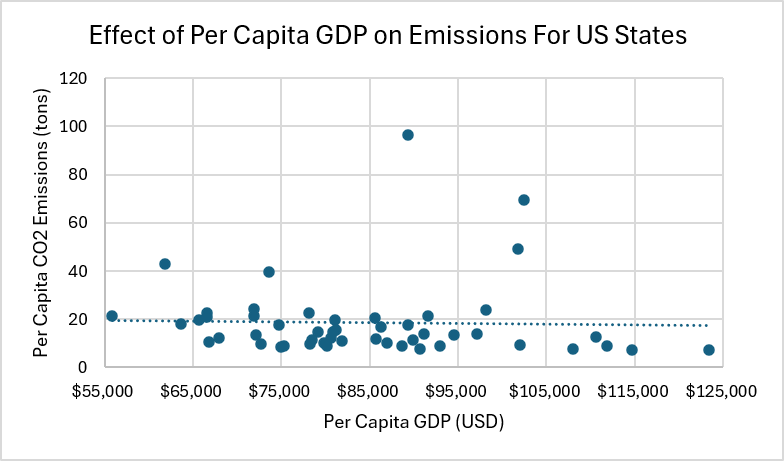
This plot demonstrates that there is no strong correlation (and in fact a very slight negative correlation) between a state’s economic prosperity and its emissions. If we look at specific states, this result should not be that surprising. New York state, for instance, has a per capita GDP of $123,000 and per capita CO2 emissions of just 7.1 tons. West Virginia has half the per capita GDP ($62,000) and six times the per capita CO2 emissions (43 tons). GDP is essentially a non-factor when we talk about what drives the differing environmental impacts of wealthy economies. What really affects emissions are relatively easy to understand factors like population density and the amount of clean generation in the power grid. Here is a scatterplot showing how states with higher population density have lower per capita emissions.
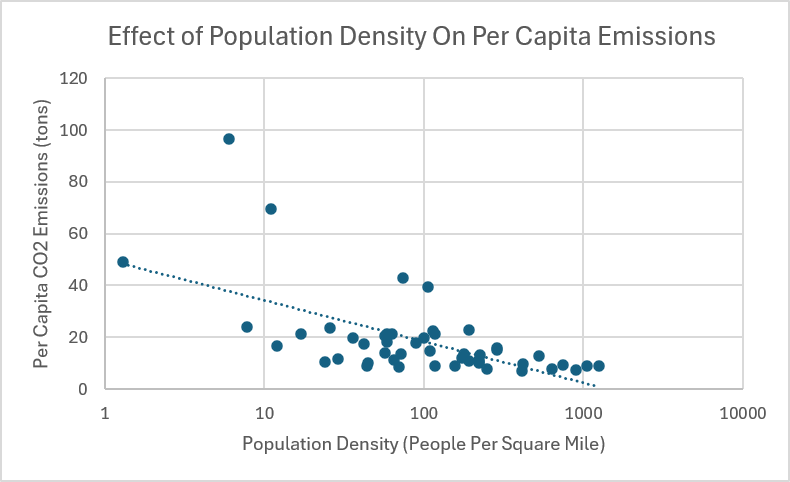
This plot shows a clear negative correlation between population density and per capita emissions. That is to say, people who live in dense cities have lower emissions than people who live in rural regions.1 This graph has a strong correlation of R = -0.6 (this is to say that population density alone accounts for about 36 percent of the difference in per capita emissions between states).
Likewise, here is a scatterplot showing how states with a higher share of clean electricity generation have lower per capita emissions.
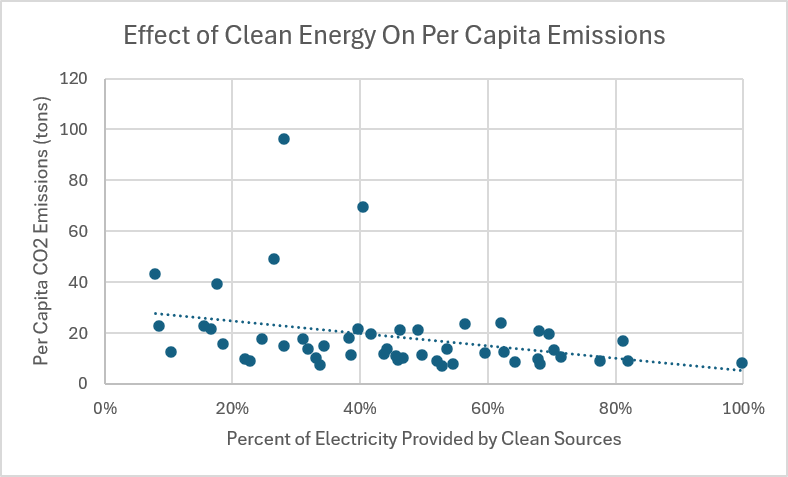
This graph has a somewhat weaker correlation of R = -0.32 (clean energy accounts for around 10 percent of the difference in emissions between states). Regardless, both correlations are much stronger than that of per capita GDP. In some ways it should be entirely unsurprising that population density and clean energy penetration would have such large effects on emissions. Electricity and transportation are some of the largest emission generators, regardless of income. Piketty could have written a report claiming that we need to fight climate change by decarbonizing electricity generation and increasing the share of people who live dense urban cores, but that report would not have been controversial, and it would not have allowed him to beat his income-inequality drum.
Proponents of degrowth would likely have a problem with my choice in graphs. They would point out that New Yorkers, while perhaps not emitting themselves, import plastic from Louisiana and steel from Indiana. These imports carry embedded emissions that would tend to level out across the various states. A better picture could be rendered by looking at consumption-based emission. This critique has some legs and if I could find reliable consumption-based emission data for US states, I would have used that instead.
I was, however, able to find consumption-based emission data at the country level. I have included a plot below which showcases the relationship between per capita consumption-based emissions and per capita GDP for a set of developed countries.
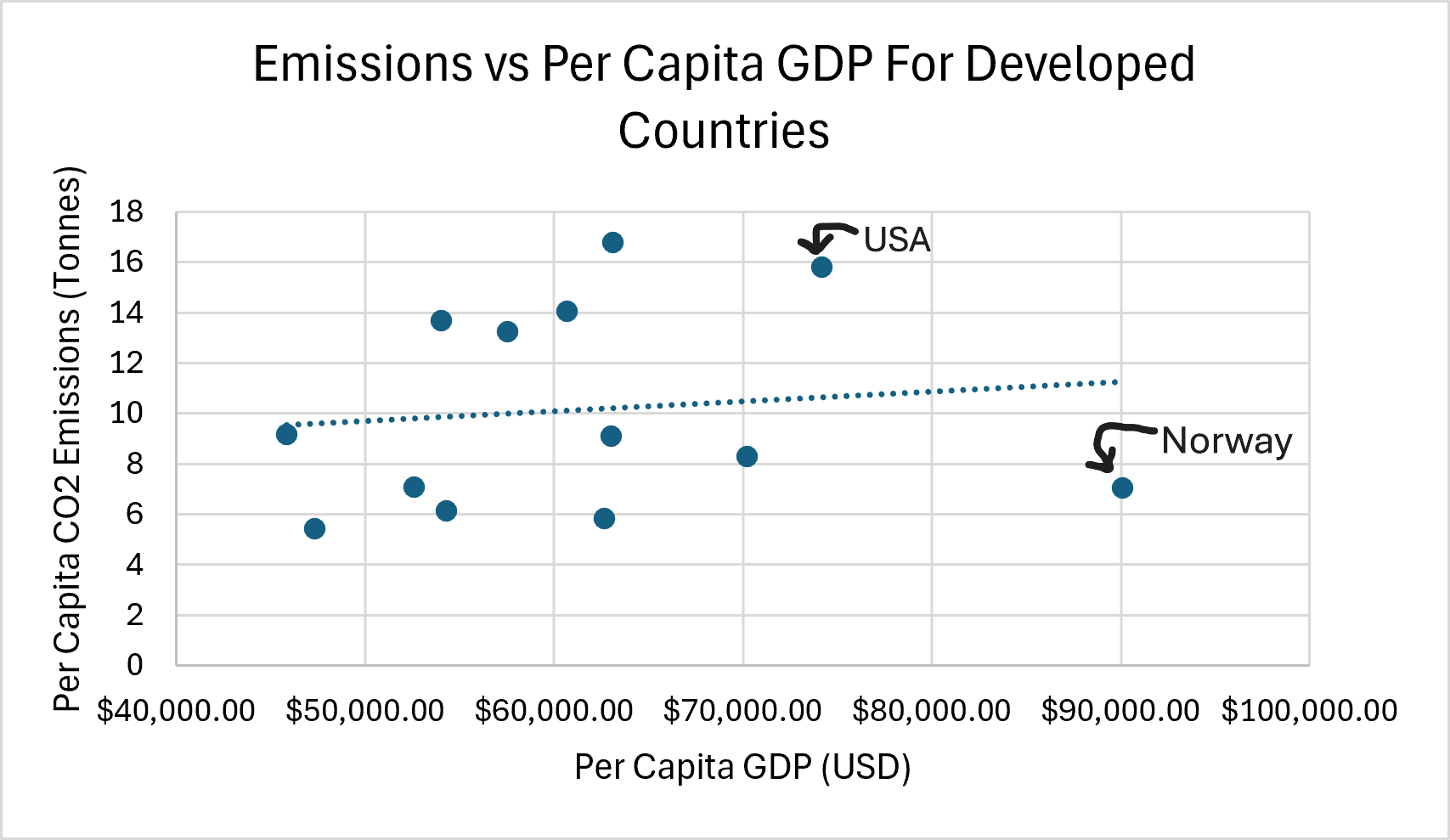
For this data we see a small correlation of R = 0.12 between Per Capita GDP and Per Capita Emissions (enough to account for about 1.3% of the variance). But once again factors like population density and clean energy are much more important. Norway is substantially richer than the United States, on a per capita basis, yet has half the per capita consumption-based emissions. This is because Norwegians live in cities, get almost all of their electricity from wind and hydropower, and have nearly complete electric vehicle adoption.
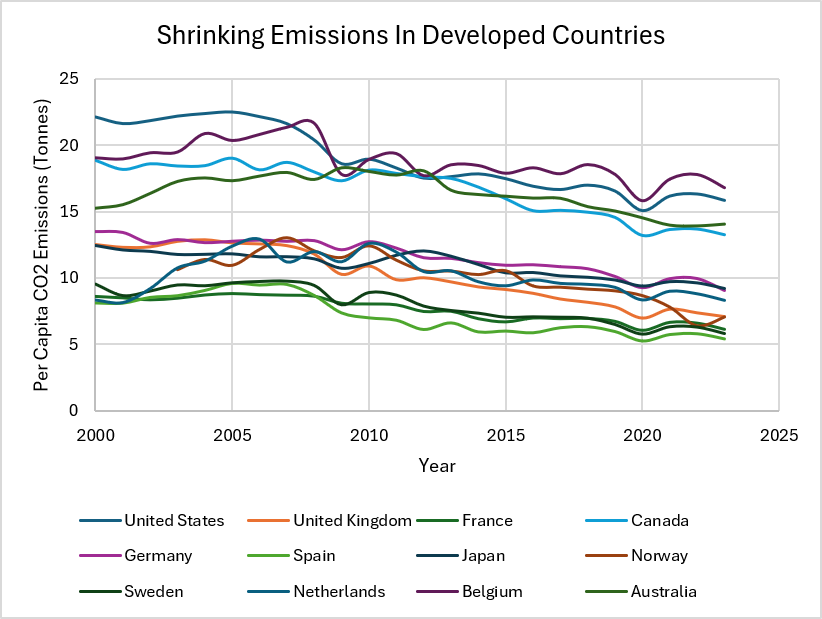
One might argue that it is hard to draw cross-country comparisons since countries are so different from one another. Perhaps we can understand the matter better by looking at the variation in GDP and emissions within countries at different points in time. Below is a graph of how consumption-based emissions have evolved since the 2000s in our selection of developed countries. The immediately apparent trend is that emissions have been declining in all of these developed countries since the early 2000s.
Then below is a graph of real GDP growth for the same countries over that period. The trend has been rising real GDP in every country.
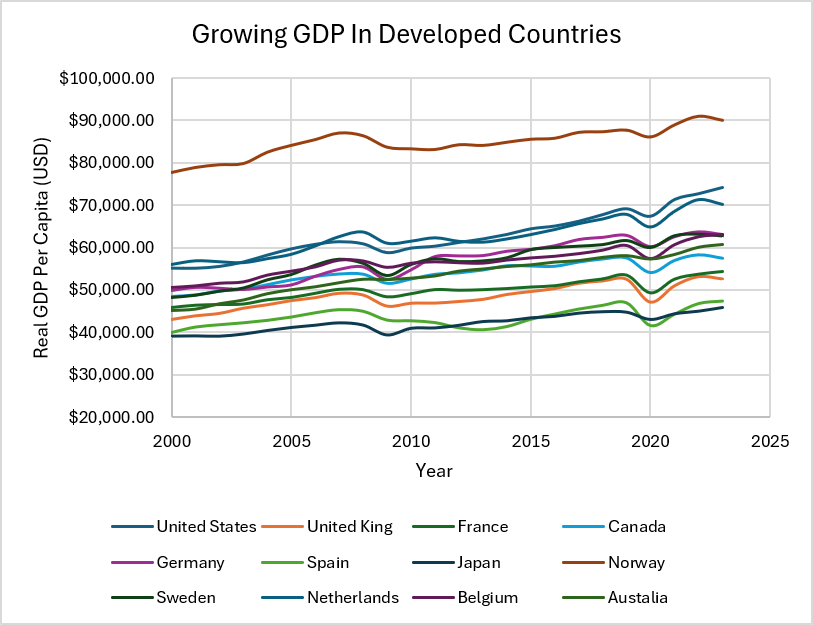
The fact that CO2 emissions have been falling while GDP has been rising is referred to as “absolute decoupling”. Wealthy economies decoupling means that there is no longer a strong correlation between economic growth and increased emissions in these countries. Degrowth advocates will point out that the emissions reductions we see in these graphs are nowhere near fast enough to reach Paris climate goals. I wouldn’t disagree, but it isn’t clear that stopping growth will help to reduce emissions any faster. Since 2000 the UK has both cut emissions faster and grown faster than Greece. They didn’t have to snuff out their growth to cut emissions, they simply built a bunch of windmills.
If anything seems likely to radically cut global emissions, it is denser city-oriented housing (which increases economic growth since cities are more prosperous than rural areas), the proliferation of batteries and renewables (which is easier to do in wealthier countries), and electrification (again, easier to do in wealthier countries). What’s more, while upzoning for denser housing is politically contentious in its own right, expanding green technologies is broadly popular. Both are more politically feasible than installing a cap on GDP growth.
Framing economic growth as antithetical to solving climate change serves only to hurt climate action in the eyes of the public who generally want additional wealth. This could perhaps be overlooked if it was a truly useful framework, but it isn’t. West Virginians are much closer to Piketty’s €60,000 optimal global income, but are obviously more destructive to the climate than New Yorkers. New Yorkers do not need to impoverish themselves to lower their emissions, nor do New Yorkers need to impoverish themselves to allow other countries to develop.
Ultimately attacking climate change with degrowth is like trying to pound in a nail into a 2x4 with a spoon; it’s not the right tool for the job. If you actually want to fight climate change, there are much better uses of your time. Promote nuclear and renewable electricity generation. Promote public transportation and urban density. Promote this blog to all your friends. Promote heat pumps and electric vehicles. Promote plant-based diets and synthetic meat. Degrowth is at-best a distraction from these more effective and growth-compatible endeavors.
Don’t let the logarithmic scale on the x-axis confuse you. It’s just used to fit this data because there are diminishing returns to population density.
The most systematic review of the evidence on decoupling I am aware of is Haberl et al. A systematic review of the evidence on decoupling of GDP, resource use and GHG emissions. There is zero evidence of absolute decoupling at a gobal scale and/or that it can be achieved at a pace to keep us within safe climate change limits.