
Electrification Will Not Stop Climate Change
But It Will Buy Us Time

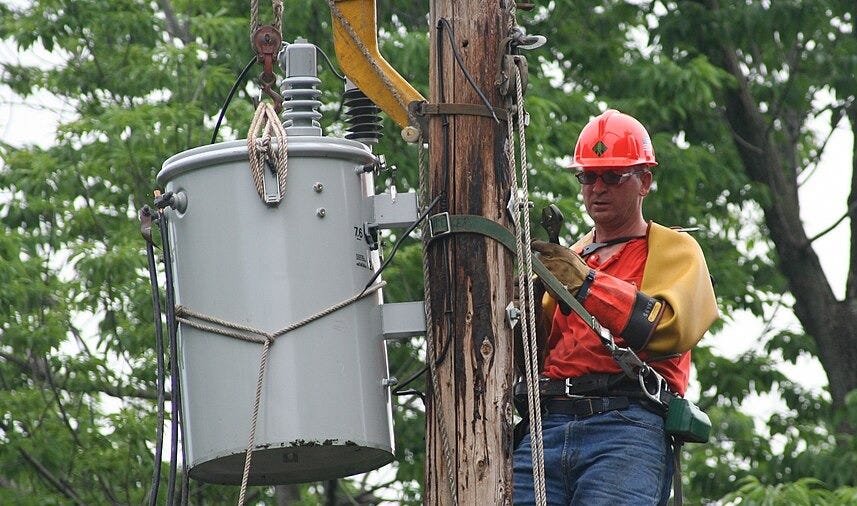
You likely have a mental image of what I mean when I call for a green transition. It probably includes some in-vogue technologies like solar panels, wind turbines, and electric vehicles. If you are a nerd, you might add batteries, heat pumps, and nuclear reactors, but those are refinements of the same basic idea. When I call for a green transition, I am primarily calling for two things: clean energy and electrification. Clean energy is straightforward. We need a higher share of our electricity to come from renewable energy and a smaller share to come from coal. Electrification simply refers to getting rid of machines that use fossil fuels (i.e. cars, furnaces, and gas stoves) and replacing them with electric alternatives (i.e. electric vehicles, heat pumps, and induction stoves). Both clean energy and electrification help to reduce emissions on their own but are most effective when pursued as part of a combined strategy.
When you look at the data, though, we can see that even an aggressive combined strategy is not sufficient to stop climate change. To understand why, we have to look at where our emissions actually come from. The data presented below was provided by Our World in Data.1
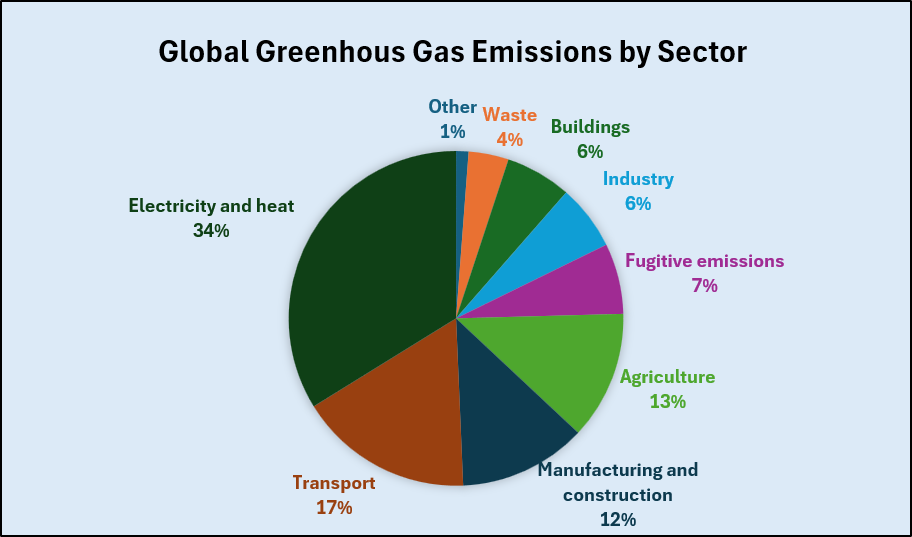
Perhaps unsurprisingly “electricity and heat” and “transport” are the two largest sources of emissions. These are precisely the areas that would be targeted by clean energy and electrification and together they account for 51% of total emissions. Beyond this, there are knock on effects. For instance, fugitive emissions occur when gasses like methane leak into the atmosphere during fossil fuel extraction. If we cut down on fossil fuel use, we could also expect that to fall, bringing us to 58% of emissions. Of course, a completely renewable grid is much harder than a mostly renewable grid, so maybe we won’t completely decarbonize our electricity supply. Additionally, some transportation emissions come from air travel and shipping which require high energy density fuels that are not well suited to electrification.
Let’s just apply a rough estimate and assume we can cut global emissions in half with clean energy and electrification. The remaining half of emissions are much harder to abate. These include, but are not limited to, emissions from high temperature industrial processes like steel, cement, and fertilizer production and long-distance transportation like air travel and shipping. A straightforward reading of this data implies we could get 100% of our electricity from clean sources and achieve 100% adoption of electric vehicles and heat pumps but still fail miserably to curb total emissions.
In the face of this failure, many will conclude that clean interventions are simply not that important. We cannot realistically address the lion’s share of emissions, so why bother. This framing is misguided, but to understand why we need to start analyzing emissions as part of a larger carbon budget framework.
Whereas a household budget tells you how much money you can spend before you go broke, a carbon budget tells you how much carbon dioxide you can emit before climate change reaches some dangerous threshold. Today, given current policies, the world is probably on track for around 2.8°Celsius (5.4° Fahrenheit) of global warming. If we instead want to limit global warming to the Paris goal of 1.5° Celsius (2.7° Fahrenheit), our carbon budget would be around 170 billion tons. This just means that we are likely to exceed 1.5° Celsius of warming if we emit 170 billion more tons of carbon dioxide. Today, the world is emitting around 42 billion tons per year, so we will exhaust this budget in about 4 years. If we accept 2° Celsius (3.6° Fahrenheit) worth of warming, our carbon budget expands to approximately 1,055 billion tons, or around 25 years of current emissions. Essentially if you want to limit global warming to 1.5° Celsius, you have 4 years to completely decarbonize the global economy. If you want to limit global warming to 2° Celsius, you have 25 years to completely decarbonize the globe. While by no means easy, a 25-year sprint to net zero is far closer to being achievable than a 4-year sprint.
The existence of hard-to-abate sectors, when considered in relation to these carbon budgets, actually makes the deployment of clean energy, electric vehicles, and heat pumps far more urgent. Not less.
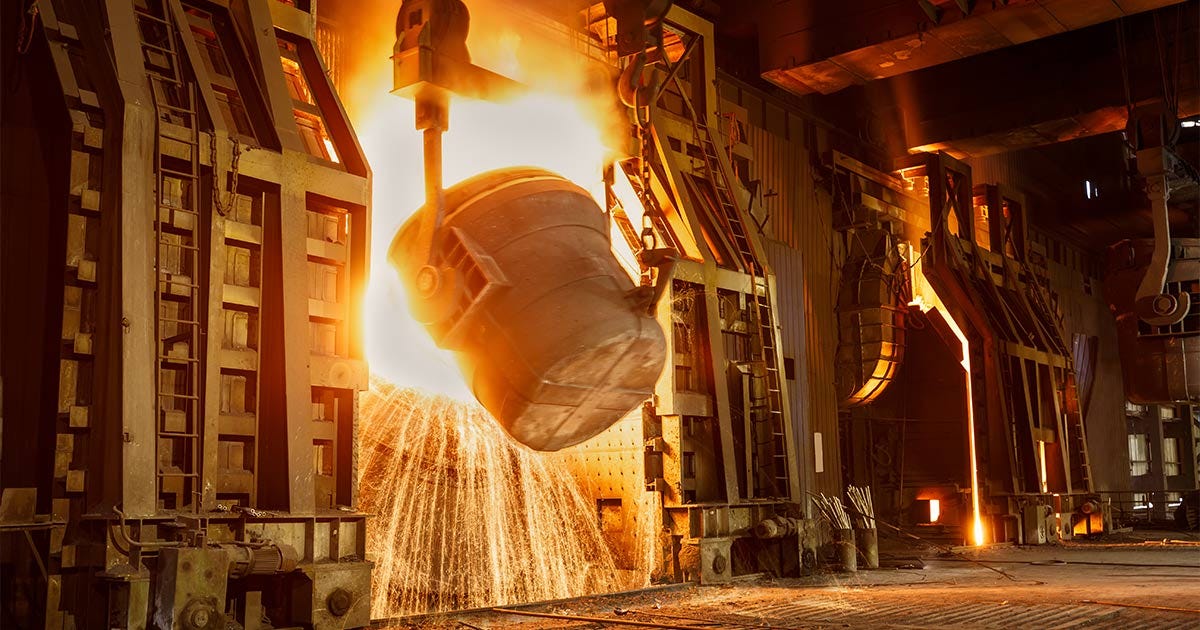
Since our civilization requires the existence of steel, concrete, and fertilizer and we don’t yet know how to decarbonize them, we need scientific breakthroughs. We have some ideas of what these breakthroughs might look like. The green steel of the future, for instance, might rely on direct reduction of iron ore with green hydrogen. Green concrete might use basalt instead of limestone in its cement and use electricity instead of gas in its kilns. These alternatives work in laboratories but will likely require decades to approach cost parity with traditional processes (even accounting for a moderate carbon tax).
The breakthroughs that will get us to zero-emissions are hard to predict, and it would be unwise to bet on multiple unrelated scientific breakthroughs simultaneously revolutionizing every area of industry in time to save us from climate change. But it is uncontroversial to suggest that over longer time horizons, these breakthroughs become more likely.
Rapidly deploying clean energy and electrification is low hanging fruit that helps to conserve the remaining carbon budget and buy us time for the breakthroughs needed to reduce emissions to zero. Below I demonstrate two scenarios. In the first scenario, we keep emitting at our current pace and exhaust our 2° Celsius budget in 25 years. In the second scenario, we spend the next 10 years focusing on those sectors that are relatively easy to abate and consequently last 45 years before exhausting our carbon budget.
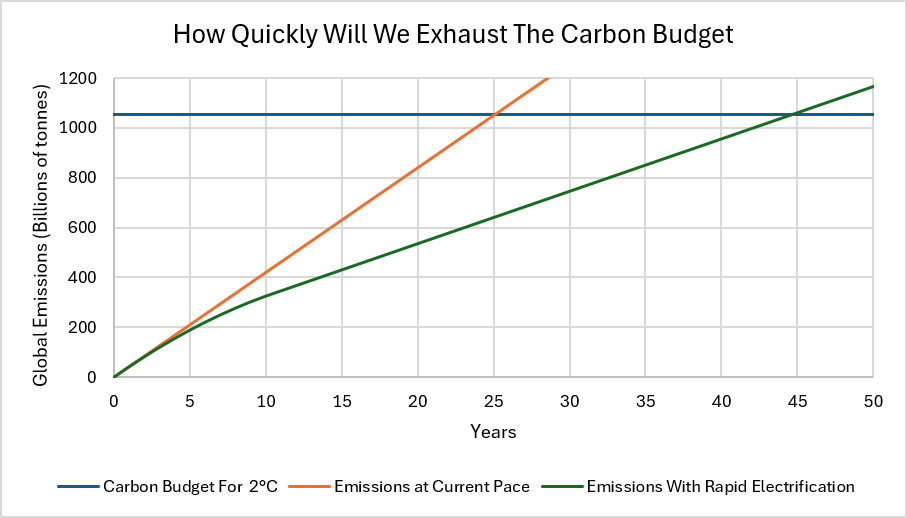
This is of course an overly simplistic model of emissions. As developing countries rise out of abject poverty, we should expect their emissions to rise, both in the easy to abate and hard to abate sectors. This model also relies exclusively on emission reduction whereas many models also consider technologies like direct air capture which seek to pull carbon dioxide out of the air after it is emitted.
Without a far deeper analysis, it is hard to say for certain how much time clean energy and electrification will buy us, but it’s on the order of decades and decades matter a lot when we’re talking about scientific and technological breakthroughs. 2 decades ago, the US got half of its electricity from coal, cheap solar was a pipe dream, and Tesla was announcing its very first electric roadster. Today we get less electricity from coal than we do from renewables, solar is cost competitive in most markets, and 25% of vehicles sold globally are electric. Far from being insignificant, every innovation, once implemented, helps to slow emissions and extend the time available for future innovations in a virtuous cycle of socio-technological progress.
This chart does not account for land use such as deforestation which would make agriculture (and particularly animal agriculture) look much worse. Still, it is sufficient for our discussion.